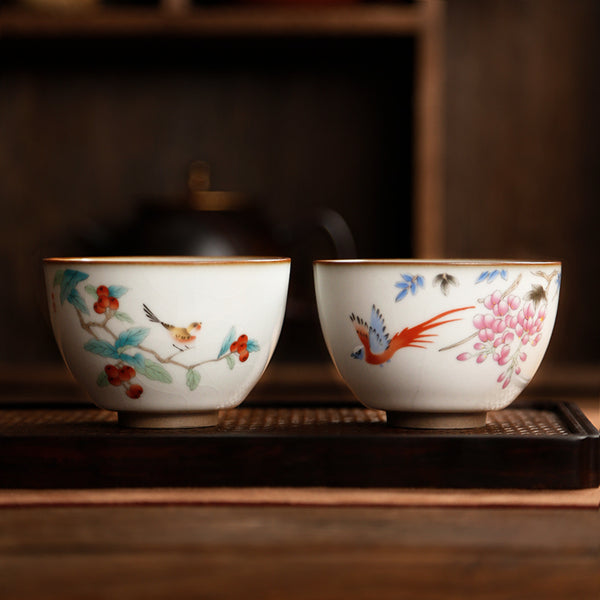

When Simplicity Became an Art - The Quiet Beauty of Song Dynastic Ceramic (Part 1 of 2)
When we think of Chinese ceramics, we often imagine brilliant blue-and-white porcelain, elaborate decoration and rich colours. Yet almost a thousand years ago, Chinese ceramic artists created something remarkably different.

During the Song Dynasty (960–1279), beauty was often found in simplicity.
Forms became quieter, colours softer and decoration more restrained. A simple bowl, cup or vase could be admired for its graceful shape, subtle glaze and sense of balance rather than elaborate ornamentation.
This became one of the most refined periods in the history of Chinese ceramics.
A Different Way of Seeing Beauty
The Song Dynasty was a remarkable period for Chinese culture. Poetry, painting, calligraphy and philosophy flourished alongside ceramics, and scholars developed a deep appreciation for nature and the subtle beauty of everyday objects.
Rather than seeking beauty through excess, artists looked for harmony, proportion and simplicity. This is one reason Song ceramics still feel surprisingly modern today. A contemporary minimalist ceramic may have a simple form, a quiet colour and little decoration. Its beauty comes from its shape, texture and the feeling it creates.
The same philosophy can be found in Song ceramics. Let us explore a few in the following:
Ru Ware – The Beauty of Restraint
Among the famous Song ceramics, Ru Ware (汝窑) is perhaps the finest expression of this quiet aesthetic.

Produced for a relatively short period during the Northern Song Dynasty, Ru Ware is famous for its delicate blue-green glaze, often compared with pale jade, mist or a clear sky after rain. The forms are generally simple and elegant. There is little need for elaborate decoration because the glaze itself becomes the decoration. Under changing light, subtle variations in colour and texture appear across the surface. Fine crackles may add another layer of character.
The beauty is quiet rather than dramatic. Ru Ware invites us to look closely.
Ding Ware – Elegance in White
Ding Ware (定窑) offers another expression of Song refinement. Famous for its fine white porcelain, Ding Ware often features delicate carved or impressed decoration inspired by flowers and nature. Even when decorated, the design remains harmonious with the form. Nothing feels excessive.

This balance between form, decoration and function became an important part of Song artistic culture.
A Legacy That Feels Modern
Perhaps the most fascinating quality of Song ceramics is how naturally they fit into modern life.
A softly glazed Song-inspired cup can sit comfortably on a contemporary tea table. A simple celadon vessel can look just as elegant in a modern home as it would have centuries ago.
Why does this aesthetic continue to appeal to us?
Because its principles are timeless: natural colours, graceful forms, quiet surfaces and simplicity without emptiness. These qualities are especially meaningful in tea culture. A tea cup is something we hold, touch and look at while taking a moment to slow down.
The Song Dynasty reminds us that beauty does not always need to be loud. Sometimes, the simplest object can speak the most quietly—and stay with us the longest.
End of Part I
In Part Two, we will explore Jun Ware, Guan Ware and Ge Ware, and discover how colour, crackle and the unpredictable nature of the kiln became part of the beauty of Song ceramics.

Check out beautiful Chinese ceramics at
www.TPotsOriental.co.uk to find your beauty in heart!!!